Byrd Creative Services'
Luthier Workshop

Making Stringed Instruments
If you're looking for a beautiful, perfectly-designed stringed instrument, you should probably look elsewhere.

If you're interested in the creation of a
functional, handmade instrument, then you might like this page!
Project 1 : Three-Stringed, Fretless, Acoustic-Electric Bass Guitar
Background: For several years I've been thinking about buying an acoustic bass guitar.  I really couldn't justify such a purchase, but thought that trying to build a bass guitar would be a decent project to devote some of my vacation time to.  Twenty years ago, when I was on the Philippine Islands, I bought an inexpensive 12-string guitar that was made of  particle board!  It played well and demostrated to me that expensive woods were not necessary in the creation of a functional guitar.  I wish I had kept that 12 string.  
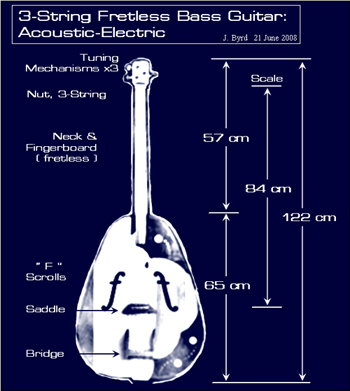
Planning: Since this would be my first attempt at making a stringed instrument, I decided to simplify the design as much as possible.  With this goal in mind, I decided not to include any frets on the fingerboard.  The lack of frets is not unheard of in the world of stringed instruments: members of the violin family have done quite well without them.  Fretless guitars and bass guitars are uncommon, but available commercially.  Some folks even have a professional luthier remove the existing frets from their guitars.  A guitar without frets allows the saddle placement to be adjustable: this offers a wide selection and variation of scales.  Usually guitars have the bridge & saddle combined together as one unit; my guitar has a "floating saddle" and ~30cm of space in which it can move (see blueprint below).  Frets restricts the saddle to one precise location: any mistake in the placement of the frets & saddle would ruin the guitar. 
Materiel: I was not terribly confident in my wood-working abilities, let alone whether I could construct a guitar that wouldn't collapse, or play well, so I kept the materiel costs to a minimum:

-- $40.00 Tuning Mechanisms (had to buy a minumum of 4)
-- $ 2.50  Bass Nut for 4 stringed bass guitar (cut 4th slot away)
-- $ 1.50  Plastic Saddle for the strings to rest on (bought 2)
-- $ 0.00  Bass guitar strings (donated by the Music Store--thanks!)
-- $25.00 Small cuts of wood, various dimensions for structural support
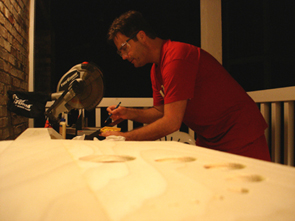
-- $25.00 Flat cuts of wood to construct front & back of soundbox
-- $36.00 Veneer, three sheets of, for side construction & ornimentation
-- $50.00 Piezoelectric pick-up to allow amplification & digitization
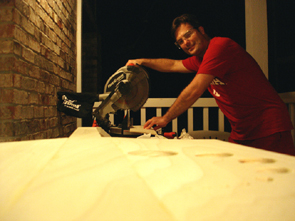
-- $25.00 Woodworking tools, sandpaper, varnish, etc....  
TOTAL ~ $200.00

Most of the wood was inexpensive pine & spruce.  The back of the body was made with thin plywood, the front was spruce.


*access to a well-equipped woodshop deferred much of the costs and saved many hours of labour. 
Thanks to Hewie, Jerry & Mark Byrd for the use of these facilities & for their helpful suggestions!
To be honest, the Blue-
Prints to the right were
made
after I had finished the guitar (it was much easier than trying to build the guitar to the specifications of my original plans).

Still, the finished product is very close to the original design.
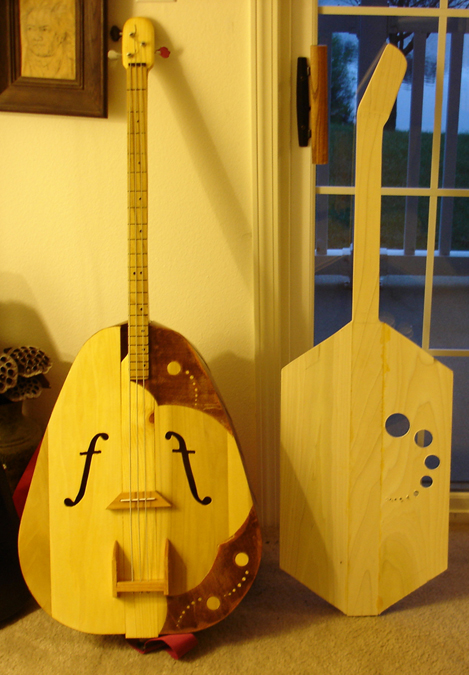
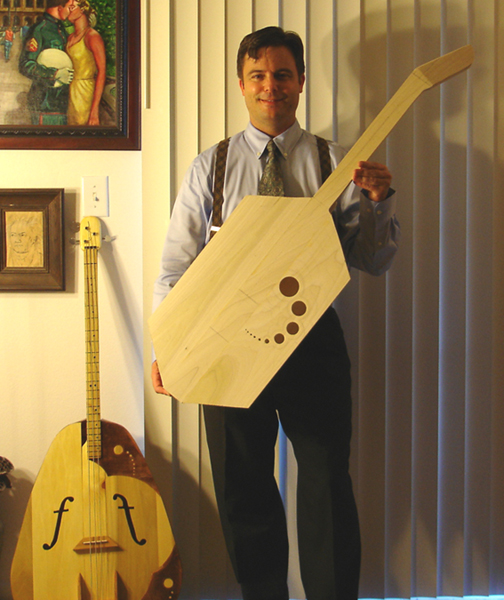
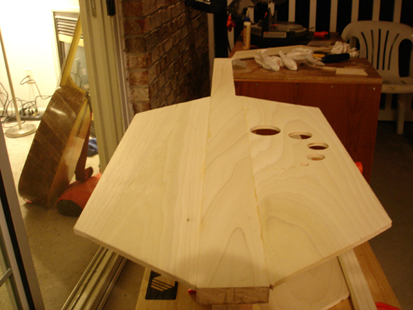
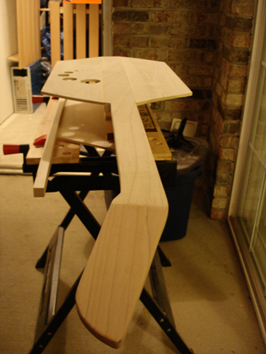
Construction: My main concern was the strength of the guitar's neck in withstanding the pull of the strings.  Placing a metal brace (usually adjustable) within the neck is an industry standard, but beyond the scope of this project.  Instead, I built the neck to be contiguous with the entire body of the guitar: it is a single, 4-foot long piece of wood running the length of the instrument on the front side

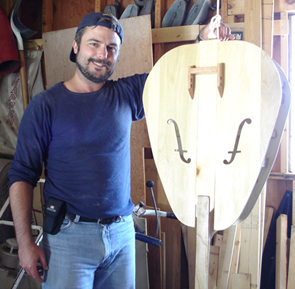
To maintain this structural support, I decided to carve "F-Holes" or "F-Scrolls" away from the midline, instead of the typical center sound hole.  Drilling such  a hole would have severely weakened the guitar.
Construction (continued):
For additional support, two arches were placed at the Neck-Body Juncture (the Proximal Arch) & at the very bottom of the guitar (the Distal Arch).  These arches gave the guitar its 15cm depth, and are structurally connected--forming a tight oval-shaped frame from the top to the bottom of the guitar's body, on both the front and back sides.


I'm sure a common problem with beginning luthiers is the over-building of their instruments.  As you can see, the internal support structure of my guitar is probably over-done, by a factor of 3-4.  As my learning curve progresses, future projects will increasingly scale-back on the amount of internal structural support.       
I'm getting ready to apply polyurethane to the suspended guitar, 5 yards behind me is Portage Lake, in Michigan's Upper Peninsula
Primary Test: Before the guitar was finished, I decided to "lace-'er -up" and see how the strings & guitar interacted.  Before I would continue building this guitar, I had many questions that needed answering:
 
1- Would the strings align properly along the neck?
2- Would the bridge support the pull of the strings?
3- How would the strings lay on the saddle?
4- How well would the saddle transmit the string vibrations to the body?
5- Were the strings too high, or too low from the fingerboard?
6- Would the neck support the pull of the strings without crumbling?
7- How did the guitar feel when held in the playing position?
8- How did the guitar play at this stage?
9- Were there any modifications, or corrections that I needed to address at this point?

I was pleasantly surprised with this initial test.  Everything pretty-much lined-up & functioned as I thought it would.  Even at this stage I was able to play it a bit.  The lack of frets prompted me to pay much closer attention to the tones I was producing--learning to make small, quick adjustments in fingering when a tone was too flat or too sharp.      
Strung-up for the first time !
Finishing Touches: Since this is my first project, I will probably be tinkering with it as long as I am able to.  I had some left-over veneer which I used to make a decorative pattern on the front of the instrument.  I might add a design to the other side--maybe not.

The sides were made of a veneer, and I needed to add two layers of this veneer at critical points.  I needed its flexibility to follow the curves of the instrument, but the sides had "soft spots."  Placing the secondary veneer with its grain at a right angle to the primary veneer strengthened-up the sides.  I could add another complete layer of this veneer along the sides, but it isn't necessary.

I have reversibly-mounted the piezoelectric pick-up on this guitar and am able to amplifily and digitize the sounds it produces.  Since I plan to create other instruments, I will not permanently mount the pick-up on this guitar.  I want to be able to switch the piezoelectric device to several instruments.

Lastly, making a hollow-body instrument was much more difficult than making one with a solid body, but I think it was much more rewarding.  It was a good exercise in planning, critical thinking and goal accomplishment.  I'm already planning Project 2 !
                                                                 --JPB
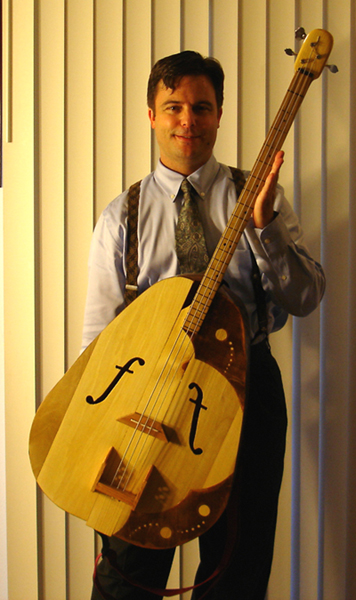
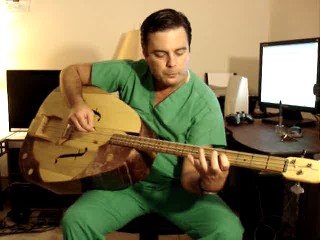
Guitar in playing position # 2
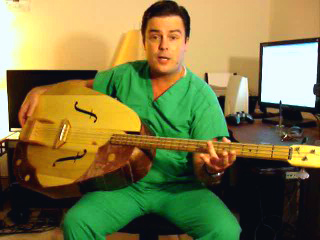
Posing with my recently-constructed,
3-String Fretless Bass Guitar !
See & Hear the Results
Meet the First Guitar I've Made
Watch & listen to me play the bass guitar that I designed & built.  For this first project, my objective was to create a playable instrument.
Watch a short video clip where I introduce you to the guitar I designed & built
If you are interested in more information, or wish to contact me, please send me an e-mail.
E-Mail Jim
Return to the BCS Index Page
The design of this 3-String Fretless, Acoustic-Electric, Bass Guitar is the property of J. Byrd  (c) 2008